Connect shop-floor data to business systems and AI
The gateway collects and standardizes; Bivrost Cloud brings monitoring, analytics and management together. Business systems, custom agents and MCP-enabled AI assistants read equipment data through open interfaces.





































Machines keep producing data.
Applications may still be unable to use it
Equipment of different brands, generations and interface conditions produces status, alarm, count and process signals in different forms. Making that data available to management platforms, business systems and AI applications still requires device connectivity, continuous collection, consistent definitions and access control.
Limited device access
Legacy equipment may have no directly readable communication interface, while different controls use different protocols. The access path must be verified against the model, interface and site network.
Inconsistent definitions
The same state or metric may map to different points and algorithms across machines. Without edge normalization, OEE, utilization and downtime cannot be compared directly.
A broken path to use
Even available data may still move through inspections, transcription, file copying, manual entry and summaries. It reaches management late and remains difficult for business systems to use continuously.
One connection, data usable everywhere
Gateway to cloud, one platform
The gateway absorbs device differences at the edge; Bivrost Cloud centralizes management and analytics. The same interfaces work locally and remotely, ready for business systems, dashboards and AI applications.
Bivrost Gateway
Four machine types, one set of data points. The gateway connects CNC machines, laser cutters and welders, robots, PLCs and legacy machines with no native interface, then cleans, converts and maps alarms.
- 4
- machine types
- 255
- devices per gateway, max
- 100 ms
- regular sampling
Bivrost Cloud connects gateways across sites for remote access to equipment data.
Gateway product pageBivrost Cloud
Status, OEE and output in one view. Asset records, maintenance and spare parts managed centrally; program transfer runs through the gateway.
- 5
- asset-management modules
- 3
- deployment options
- MCP
- access to a selected gateway
Public cloud, private cloud and on-premises deployment, with Factory AI included.
Cloud product pageOpen interfaces
Five channels, one dataset. HTTP, MQTT, MODBUS, direct database writes and MCP each integrate applications; Claude, Cursor and other AI assistants connect directly.
- 168
- HTTP endpoints
- 13
- MCP tools
- 4
- databases, direct write
Per-user keys plus an authorized-API list: access control at endpoint level.
Developers & integration For factory digitalization,
and for developer integration
Manufacturers connect a shop floor at a time; software vendors ship their own products with the gateway as the device layer. Both use the same interfaces and the same data definitions.
Digitalization and equipment leads
Gateway plus Bivrost Cloud, delivered together. Machine state, alarms, OEE and output flow into the platform automatically; repair, inspection and maintenance run inside it, with Factory AI included. Add your own dashboards or another AI tool later on the same interfaces — no second round of data collection.
- Connection options for CNC machines, laser cutters and welders, robots, PLCs and legacy equipment
- Public cloud, private cloud and on-premises run the same code
- Define the data definitions once; shifts, reports and AI all read the same one
Reports roll up automatically; spreadsheet and import/export hours go away
Alarms and stoppages visible live, with causes on record
Equipment history and repair records stay on the platform when personnel change
MES, industrial apps, system integrators
The gateway is the device driver layer. CNC machines, laser cutters and welders, robots and PLCs converge into one set of interfaces and data definitions — no new driver per plant. At a new site, configure gateways for the equipment and reuse the existing integration logic.
- Five northbound channels on gateway and cloud alike: HTTP, MQTT, MODBUS, direct database write, MCP
- Up to 255 machines per gateway on one LAN
- Per-user keys plus an authorized-API list: grant your app exactly the endpoints it needs
- 168
- HTTP endpoints
- 13
- MCP tools
- 4
- databases, direct write
- 100 ms
- regular sampling
Equipment builders: the gateway can be pre-installed into a machine or a line and shipped with it.
Applications already running on this platform
Bivrost applications, partner platforms and software products use gateway interfaces for functions ranging from equipment data queries to CNC program management.
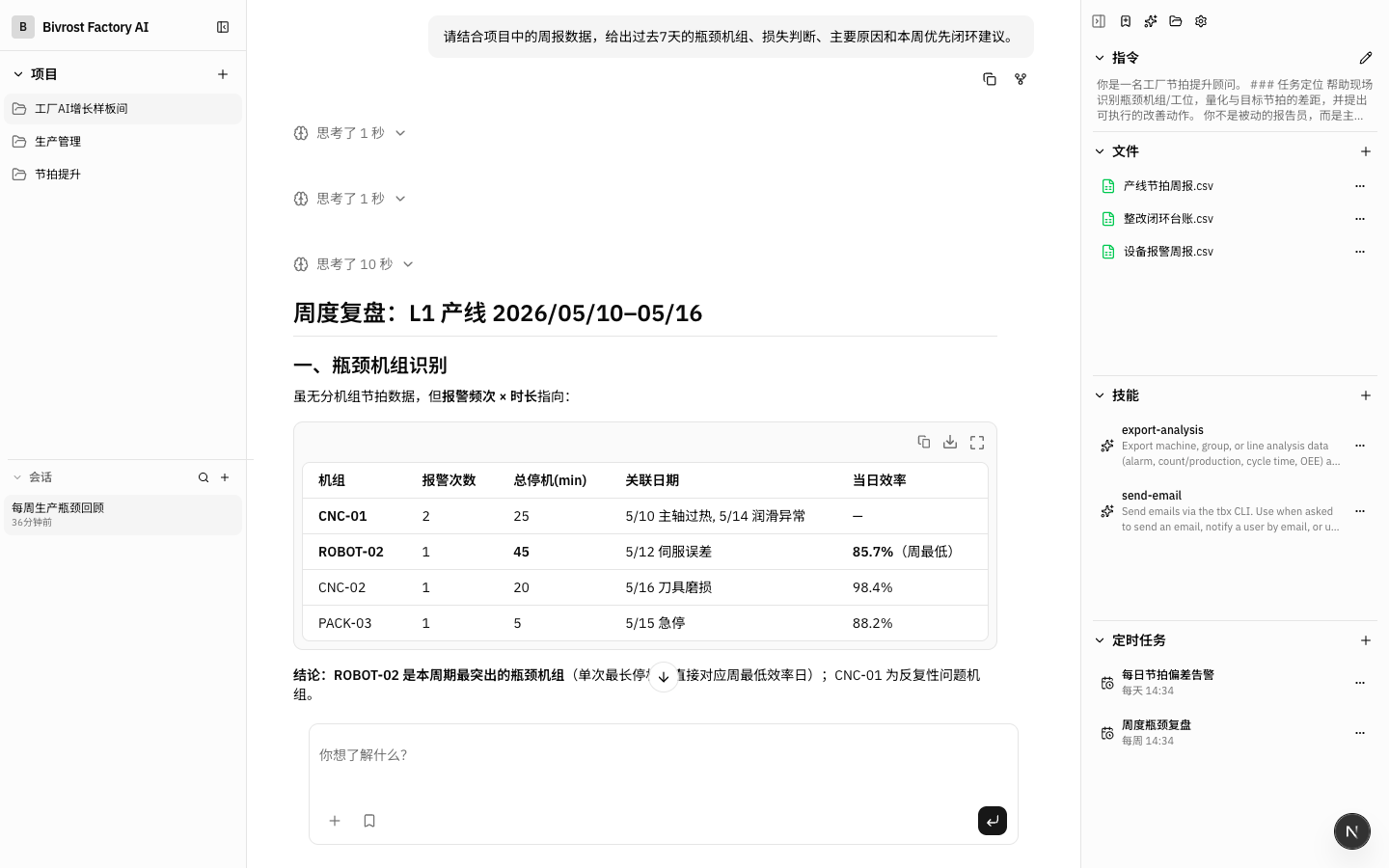
Factory AI
Bivrost’s own AI application, built on the same platform and shipped with Bivrost Cloud. Natural language queries machine state, alarms, OEE and output, and generates reports automatically; the same equipment data is open to other applications through the same interfaces.
DNC Pro
Versioning, approval, six-stage controlled deployment, drift detection. The gateway handles transfer; DNC Pro handles versioning and rollout.
Product pageHexagon
One standardized interface, machine tools from multiple brands. Hexagon connects through Bivrost gateways, skipping per-brand protocol integration.
Integration caseMES and industrial apps
Integrate once, reuse across plants. MES vendors, industrial-app teams and system integrators ship their own products with the gateway as the device layer — their customers see their brand.
Developers pageServing manufacturing across industries
Bivrost supports equipment connectivity and data management across automotive manufacturing, precision medical devices, construction machinery and university laboratories.
Hexagon
Machine tool brands are many and their protocols all differ. Adapting to each system in-house would have cost Hexagon heavily in money and delivery time. Bivrost pushed multi-brand machine communication down into a single gateway, reducing protocol integration work for Hexagon’s data platform.
- Reduced per-brand protocol integration work
- Digitalization projects shipped faster
- A long-term digitalization partnership
First Fluid Power
Management follows production from automatic roll-ups; line leads watch alarms and utilization rankings on the dashboard; cloud program management replaced the USB-stick routine.
Kanghui Medical
The shop runs many machine types, much of it old. A standardized Bivrost gateway collects across all of them and feeds the enterprise systems, making downtime and maintenance cost visible.
Jiehe Motor
A customized rollout of the Bivrost Cloud equipment management modules: scan-to-report repairs, low-stock alerts on spares, three-tier maintenance checklists — all on one data foundation. Production, maintenance and quality teams work together in one place, with around 1,000 repair work orders a month.
Automotive OEM
Equipment is spread across domestic and overseas bases, with many brands and different protocols. Bivrost gateways standardize equipment connectivity, and a low-code PaaS lets management build cross-site dashboards without writing code.
Compressor parts maker
Running tools too long caused quality issues, changing them early wasted consumables, and fault response was manual. The Bivrost TMS module drives tool-change decisions from live machine data — quality, cost and response time improved together.
Bring equipment data
into everyday decisions
Book a 30-minute demonstration of equipment data integration with the platform, business systems and AI tools. Share equipment models and requirements so the demonstration can focus on the intended application.
If no message appeared, copy the text below and send it to contact@bivrost.cn.
Email enquiries: contact@bivrost.cn · Request a gateway trial